
Mandatory solar PV, electrification readiness, tighter building fabric standards, and significant implications for Green Star certification. This article covers every Section J change in detail, including the J9D5 compliance process, what gas-powered buildings must do differently, and the significant implications for Green Star certification strategies. It is relevant to builders, developers, designers, and energy assessors working on Class 3 and Class 5–9 buildings.
What Building Ministers Endorsed for NCC 2025
- Commercial energy efficiency (Section J) — mandatory on-site solar PV and tighter services standards
- Water management — improved provisions for commercial and apartment buildings
- Carpark fire safety — sprinkler requirements for open-deck carparks
- Condensation mitigation — reduced ventilation requirements for small roofs
Adoption varies by jurisdiction. The ACT has confirmed adoption from 1 May 2026. NSW, VIC, QLD, SA, WA, and NT are yet to confirm their adoption dates. Tasmania has separately indicated it is pausing NCC 2025 implementation.
Key Takeaways
- NCC 2025 introduces major updates to Section J, strengthening energy efficiency requirements for Class 3 and Class 5–9 commercial buildings.
- Mandatory on-site solar PV is now required under Clause J9D5, making installed renewable energy systems part of the DTS compliance pathway.
- Gas-powered buildings face additional requirements, including extra solar PV to offset emissions and provisions for future electrification.
- Switchboards must allow for future battery storage, with reserved space required unless a battery is installed at construction.
- Lighting and HVAC systems must meet higher efficiency standards, with stricter controls, updated ventilation rates, and improved ductwork performance.
- The NABERS verification pathway (J1V1) has been expanded, providing an alternative compliance option aligned with higher performance benchmarks.
- Mandatory rooftop solar may affect Green Star strategies, reducing the ability to use rooftop PV as a key energy modelling advantage.
Scope: Which Buildings Are Affected
Section J applies to Class 3 buildings (hotels, motels, boarding houses) and Class 5–9 buildings (offices, retail, warehouses, schools, hospitals, aged care, public buildings).
For Class 2 apartment common areas, the proposed Section J amendments were withdrawn. NCC 2022 Amendment 2 continues to apply to Class 2 common areas. Practitioners working on mixed-use buildings with Class 2 and Class 5–9 components should apply the relevant provisions to each part of the building separately.
These updates advance the Trajectory for Low Energy Buildings policy agreed by Energy Ministers in 2019. The primary driver is NCC Performance Requirement J1P1, which now carries more stringent requirements for regulated energy and associated greenhouse gas emissions.
Building Envelope Changes
Higher Deemed-to-Satisfy (DTS) settings apply to the building fabric under NCC 2025. These are not minor adjustments. The changes require designs to be reviewed against new benchmarks from concept stage to avoid late compliance issues.
Insulation
Minimum R-values for roof, ceiling, and wall construction have been increased, with requirements varying by climate zone.
Improved wall insulation requirements apply to all construction systems, including lightweight framing, concrete, and masonry.
Buildings that previously passed DTS on insulation alone will need to be checked against the revised values.
Glazing Performance
- Lower U-values required for external glazing (meaning higher insulating performance)
- Revised Solar Heat Gain Coefficient (SHGC) limits, particularly for north and west-facing facades
- Tighter glazing area ratios: The percentage of facade that can be glazed under DTS is further restricted
The NCC 2022 facade calculator (J4D6) will be updated to reflect the new DTS provisions. Until the updated tool is published, practitioners should confirm the correct version to use for NCC 2025 projects.
Building Sealing
More stringent air infiltration requirements apply to minimise uncontrolled heat loss and gain. Energy modelling must now more accurately represent actual heat loss and gain through the building envelope, requiring closer attention to detailing and construction quality documentation.
HVAC, Mechanical Services and Electrification Readiness
Significant revisions apply across all Section J mechanical services provisions. The two most operationally significant changes for builders and developers are the efficiency uplift requirements and the new electrification readiness mandate.
Higher HVAC Efficiency Benchmarks
- Increased minimum COP (Coefficient of Performance) and EER (Energy Efficiency Ratio) targets for HVAC plant
- Tighter ductwork leakage standards and higher insulation requirements for ductwork
- Revised minimum outdoor air ventilation rates calibrated to building use and occupancy type
Electrification Readiness (New)
Gas-powered HVAC and hot water systems must be designed to permit replacement with electric alternatives at end of life, with sufficient electrical capacity pre-provisioned.
This is a forward-looking requirement that affects how gas-connections, switchboard and electrical infrastructure is sized.
Clause J9D5(1) — Switchboard Requirements
All commercial buildings must now include battery infrastructure in the main switchboard:
- Minimum 2 empty three-phase circuit breaker slots reserved
- Minimum 4 DIN rail spaces reserved for future battery storage
- This requirement does not apply where a battery system is already installed from day one
This provision sits within the J9D5 solar PV clause but applies independently to the switchboard, regardless of whether PV is required. It must be addressed at switchboard design stage and reflected in electrical drawings and specifications.
Lighting Control Requirements
Updated lighting control requirements introduce more prescriptive standards across different space types. The intent is to reduce energy use during low or zero occupancy periods, where significant waste historically occurs in commercial buildings.
Key Changes
- More prescriptive occupancy sensing requirements — applies to a wider range of space types than NCC 2022
- Daylight-responsive dimming requirements for spaces with sufficient natural light access
- Time-based scheduling controls for appropriate space types
These changes interact with the energy modelling baseline. Lighting Power Density (LPD) assumptions used in J1V2 modelling will need to reflect the updated DTS controls, and any proposed building performance that relies on lighting efficiency gains above DTS should be verified against the new benchmarks.
Mandatory On-Site Solar PV — J9D5
The mandatory solar PV requirement under J9D5 is the most significant new DTS provision in NCC 2025 for commercial buildings. Previous NCC editions required only solar-ready provisions: reserved roof space and rough-in conduit. Under NCC 2025, an installed PV system is required.
Why This Is a Step Change
For the first time in any NCC edition, the DTS compliance pathway requires physical solar PV installation
Under NCC 2025, designers following the DTS pathway must undertake a systematic roof review during design to determine where solar PV will be installed. This is a design obligation, not just a services specification task.
The Two Compliance Pathways
J9D5(2) provides two options. The designer selects whichever produces the smaller resultant system size.
J9D5(2a) — Roof Coverage Pathway
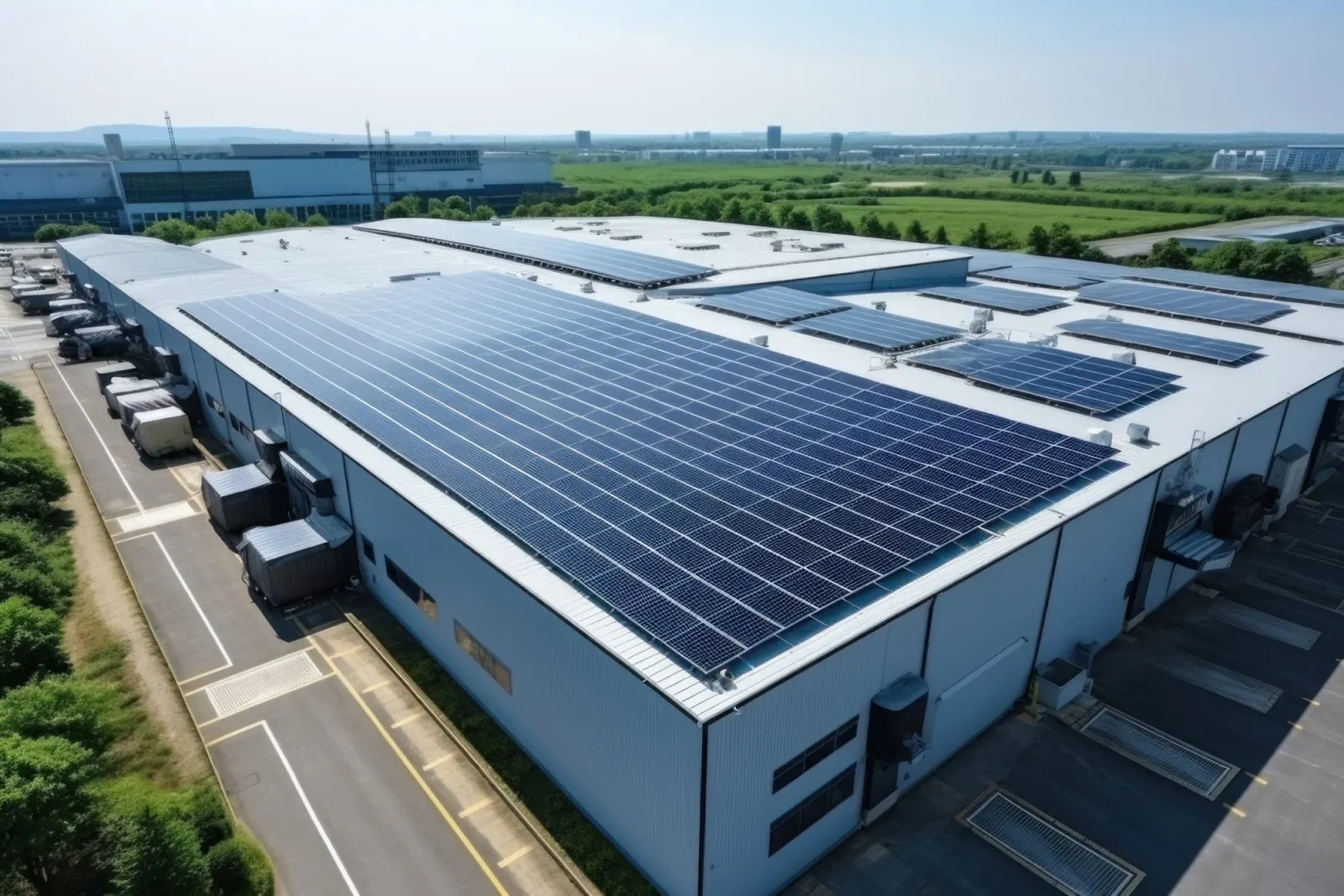
Install PV panels on 100% of available roof space. Exclusions apply for trafficable areas, plant equipment and services spaces, skylights, BMU/access areas, and any roof area shaded for more than 10% of daylight hours. Where 100% of the roof is shaded for more than 70% of daylight hours, J9D5(2) does not apply.
J9D5(2b) — Conditioned Area Output Pathway
Install a PV system with minimum output rating per m² of conditioned floor area, as specified in Table J9D5. Rates vary by building class and climate zone. Example: a Class 5 office in Climate Zone 6 (Melbourne) requires at least 65 W/m² of conditioned space.
Worked Example — Tall Commercial Building (Melbourne, CZ6)
A 28-level, 35,000 m² Class 5 office building in Melbourne illustrates the practical difference:
- Option (2b) requires: 65 W/m² × 35,000 m² = 2,275 kW (requiring approximately 11,903 m² of panels)
- Available roof area: approximately 1,800 m² — making (2a) clearly the correct pathway
- Under (2a), approximately 20% of total roof space is usable after exclusions, resulting in a roughly 40 kW array
Step-by-Step Compliance Process
The ARUP guidance material commissioned by DCCEEW (NCC 2025 Public Comment Draft Worked Example: Mandatory On-site PV) provides the authoritative technical framework. The process involves three core steps:
- 1. Assess Roof Overshadowing — Overshadowing is evaluated at the solar equinox. Any roof area shaded for more than 10% of daylight hours (typically more than 1.2 hours in a 12-hour day) is excluded. Identify all adjacent buildings and structures that may cast shadows and determine shadow depth at critical hours using solar elevation and azimuth angles for the equinox.
- 2. Determine System Size and Layout — After excluding shaded and non-suitable areas, PV panels are planned to cover 100% of remaining available roof space. Panels require a small tilt for self-cleaning. Safe maintenance access corridors must be provided. Panel layout must account for Building Maintenance Unit (BMU) locations and travel paths.
- 3. Gas Appliance Offset Assessment J9D5(3) — Where natural gas is used for building services, additional solar PV must be installed to offset the extra greenhouse gas emissions compared with an all-electric building. The additional PV is calculated from Table J9D5b. For a 35,000 m² office retaining gas boilers, this requires approximately 35 kW of additional PV at 1 W/m² of conditioned space.
Gas Buildings: The Dual-Fuel Penalty
If roof space is already fully utilised and additional panels are required under J9D5(3), the project team must consider one of three alternatives:
- Locate additional panels elsewhere on the building, such as angled facade shades (vertical wall installations are not permitted under DTS)
- Ground-mount panels elsewhere on site, such as above carparking or landscaped areas
- Use a Performance Solution or Verification Method to demonstrate equivalent or better performance without the additional panels
Full J9D5 Clause Reference
|
Clause
|
Topic
|
Requirement
|
|---|---|---|
|
J9D5(1)
|
Battery infrastructure
|
Reserve ≥2 empty three-phase circuit breaker slots and 4 DIN rail spaces in main switchboard for future battery system. Not required if a battery is installed from day one.
|
|
J9D5(2)(a)
|
Roof coverage pathway
|
Install PV on 100% of available roof space, with exclusions for trafficable areas, plant, skylights, BMU/access, and areas shaded more than 10% of daylight hours.
|
|
J9D5(2)(b)
|
Conditioned area pathway
|
Install PV with output rating per m² of conditioned space as per Table J9D5. Varies by building class and climate zone.
|
|
J9D5(3)
|
Gas offset PV
|
Where gas is used for building services, additional PV is required per Table J9D5b to balance emissions against an all-electric equivalent.
|
|
J9D5(4)
|
Gas offset PV specs
|
Additional gas-offset PV panels must not be shaded more than 10% of daylight hours and must have pitch ≤45 degrees.
|
|
Limitation (1)
|
Battery exemption
|
J9D5(1) switchboard requirement does not apply where a battery system is installed.
|
|
Limitation (2)(a)
|
Full shade exemption
|
J9D5(2) PV requirement does not apply where 100% of roof is shaded more than 70% of daylight hours.
|
|
Limitation (2)(b)
|
Alternative renewables
|
J9D5(2) does not apply where an equivalent alternative on-site renewable energy system is provided.
|
NCC 2022 vs NCC 2025: Solar Provisions Side by Side
|
Provision
|
NCC 2022
|
NCC 2025
|
|---|---|---|
|
Solar PV requirement
|
Preserve roof space and rough-in conduit for future PV. No installed system required.
|
Physical PV system must be installed. 100% of available roof space OR conditioned area output rate, whichever is smaller.
|
|
Gas-powered buildings
|
No additional PV requirement related to fuel type.
|
Additional PV mandated (Table J9D5b) to offset gas appliance emissions vs all-electric equivalent.
|
|
Battery infrastructure
|
No provision.
|
Switchboard must accommodate future battery: ≥2 empty three-phase breaker slots + 4 DIN rail spaces (unless battery already installed).
|
|
Compliance trigger
|
Solar-ready provisions only — design consideration, not installation obligation.
|
Roof review is a mandatory design step. Installation is a DTS requirement from project outset.
|
NABERS Verification Pathway — J1V1
The NABERS Energy Commitment Agreement pathway (J1V1) has been updated to align with Stringency Level 3. Modelled NABERS star ratings required to achieve NCC compliance have been revised upward, reflecting the more stringent performance benchmark set by J1P1.
The J1V1 pathway now covers a wider range of building classes than under NCC 2022:
- Class 2 common areas (new addition)
- Class 3 hotels
- Class 5 offices
- Class 6 shopping centres (GLA greater than 15,000 m²) (new addition)
For practitioners working on Class 5 office buildings, the J1V1 NABERS pathway remains a viable alternative to the DTS or J1V2 modelling pathways. Given the Green Star energy credit implications discussed in the next section, the NABERS pathway may be a better strategic fit for certain project typologies under NCC 2025.
Green Star Certification — The Emerging Conflict with NCC 2025
This section is critical for project teams targeting Green Star certification. The change to mandatory on-site PV under J9D5 creates a significant and largely unresolved tension with the Green Star Buildings Energy Use credit.
Understanding this conflict early, ideally at project inception, will materially affect the credit strategy and energy compliance pathway available.
How the Green Star Energy Use Credit Works
The Green Star Buildings Energy Use credit (Positive category) assesses a proposed building’s energy consumption against a code-compliant reference building, using the J1V2 verification pathway.
|
Credit Level
|
Requirement
|
|---|---|
|
Credit Achievement (3 points)
|
Proposed building energy use at least 20% less than the reference building. On-site renewable energy offset is included in calculating this improvement.
|
|
Exceptional Performance (3 points)
|
Proposed building energy use at least 30% less than the reference building. On-site renewable energy offset is again included.
|
|
Industrial Credit 22 (1 point)
|
At least 99 kW of solar PV per 10,000 m² of Gross Lettable Area installed on-site, connected behind the meter.
|
|
Industrial Credit 22 (2 points)
|
At least 198 kW of solar PV per 10,000 m² of Gross Lettable Area installed on-site, connected behind the meter.
|
The Core Problem
The rooftop solar lever that project teams have historically used to gain Green Star energy credit points is effectively neutralised under NCC 2025 for most mid-rise and high-rise commercial buildings.
Under NCC 2022, the Green Star reference building did not include mandatory PV. A project could install rooftop solar on the proposed building and use that generation to show a meaningful percentage improvement over the reference.
Under NCC 2025, J9D5 mandates 100% of available roof space is covered with PV as the minimum code requirement. Both the proposed building AND the reference building carry a full rooftop PV system. A Green Star project cannot install more rooftop PV than the NCC baseline to improve its percentage gap, because there is no roof space left to add panels.
Building Types Most Affected
|
Building Type
|
Specific Impact
|
|---|---|
|
Mid-rise and high-rise offices (Class 5)
|
Roof-to-GFA ratio is very low. Under J9D5, 100% of available roof space is already committed. Teams must rely entirely on envelope, HVAC, and lighting improvements to achieve the 20–30% energy reduction threshold.
|
|
Hotels and mixed-use (Class 3)
|
Similar constraint to offices. Roof space heavily competed by plant, BMU, and pool/terrace areas. The usable solar area committed by J9D5 leaves little opportunity for additional PV gains in the Green Star energy model.
|
|
Industrial/warehouses (Class 7b)
|
Large roof areas relative to GLA. The lower Credit 22 threshold (99 kW per 10,000 m²) may be met automatically by the code-minimum system. However, the higher 198 kW threshold for the second point tier may require larger systems than available roof space permits on shaded roofs.
|
|
Retail/shopping centres (Class 6)
|
Roof areas can be substantial but are competed by service plant, skylights, and loading areas. J9D5 commits available space; additional PV for Green Star differentiation is constrained.
|
Alternative Strategies for Green Star Projects Under NCC 2025
- Building envelope uplift — significantly exceeding NCC 2025 DTS requirements for glazing U-value, SHGC, insulation R-values, and air sealing.
- High-efficiency HVAC — specifying plant with COP/EER materially above the NCC 2025 minimum, including heat recovery and demand-controlled ventilation.
- Lighting system efficiency — targeting lower LPD and more sophisticated control systems than NCC 2025 DTS minimums.
- Off-site renewable energy procurement — accredited GreenPower counts toward energy performance in certain Green Star credit pathways.
- Ground-mounted or carpark PV — additional PV on ground-mounted structures or carpark canopies may be includable in the Green Star model.
- NABERS pathway (J1V1) — for Class 5 office buildings, a NABERS Energy target well above the code-minimum may provide a clearer path to Green Star credit.
Recommended Actions for Green Star Projects
- Conduct Green Star energy modelling early, ideally at concept design, to understand the actual performance gap after J9D5 mandatory PV is applied to both proposed and reference building models
- Identify alternative roof space or site locations for additional PV and confirm whether these can be included in the Green Star model beyond the NCC reference baseline
- Raise a Technical Question with GBCA to confirm how the updated NCC 2025 reference building (including mandatory PV) will be treated in the J1V2 energy modelling methodology
- Review jurisdiction-specific NCC 2025 adoption timing and clarify with GBCA whether the NCC 2022 reference may still apply if your jurisdiction has not yet adopted
- Consider whether the NABERS pathway (J1V1 at Stringency Level 3) is a better fit than J1V2 for the specific project typology
What Was Proposed But Not Included in NCC 2025
The October 2025 Building Ministers’ Meeting confirmed several proposed changes would not proceed as code provisions. Some are deferred; others are published as guidance only.
- Class 2 Section J (apartments) — Proposed Section J updates for common areas did not proceed. NCC 2022 Amendment 2 remains applicable.
- EV charging readiness (commercial, J9D4) — Proposed amendments to EV charging provisions for commercial buildings not included.
- EV charging readiness (residential) — Proposed new residential EV charging provisions not included.
- Residential energy efficiency — Volume Two Part H6 and Housing Provisions Part 13 unchanged from NCC 2022 Amendment 2.
- Voluntary embodied carbon (in-code) — Will be published as an ABCB guidance document rather than incorporated into NCC 2025.

Recommended Actions for Builders, Developers and Assessors
NCC 2025 adoption is confirmed in the ACT from 1 May 2026 and expected to follow in other jurisdictions. Projects with development approvals likely to fall near or after the adoption window should be reviewed now.
- Confirm the applicable NCC edition for your project — Adoption is jurisdiction-specific and not yet confirmed in most states and territories. Establish which edition applies to your project’s likely DA or Building Permit date and design accordingly.
- Include a roof PV assessment in concept design — For any Class 3, 5–9 project where DTS compliance is intended, a preliminary roof coverage review and overshadowing assessment should be included in concept design deliverables.
- Review gas appliance specifications — Where gas is proposed for HVAC or hot water services, confirm whether the additional PV offset under J9D5(3) is achievable within the available roof area, or whether a Performance Solution is required.
- Coordinate switchboard design with J9D5(1) — Electrical engineers should be briefed on the battery infrastructure reserve requirement at the start of electrical design. This affects switchboard sizing and cannot easily be retrofitted late in documentation.
- Review glazing specifications and insulation schedules — Updated U-values, SHGC limits, and insulation R-values will require facade and envelope specifications to be reviewed against the new DTS benchmarks.
- For Green Star projects, revisit the energy credit strategy early — The constraint on rooftop PV as a Green Star differentiator under NCC 2025 requires a shift in credit strategy. Engage your energy assessor and Green Star consultant at concept stage.
Sources:
- Australian Building Codes Board (ABCB)
NCC 2025 Preview Release — Published 1 February 2026. The primary regulatory source for all Section J commercial energy efficiency provisions referenced in this article.
Available at: ncc.abcb.gov.au
- ARUP / Department of Climate Change, Energy, the Environment and Water (DCCEEW)
NCC 2025 Public Comment Draft Worked Example: Mandatory On-site PV. The authoritative technical framework for the J9D5 compliance process, including the step-by-step roof overshadowing assessment, system sizing methodology, and gas appliance offset calculations.
Commissioned by DCCEEW. Available via the ABCB NCC 2025 consultation materials.
- Building Ministers’ Meeting Communiqué — October 2025
Confirmed the content and adoption timeline for NCC 2025, the formal pause on residential energy efficiency changes, and items not proceeding as code provisions. The basis for Section 8 and all adoption date references.
- Green Building Council of Australia (GBCA)
Green Star Buildings v1.1 — Credit criteria and scoring methodology for the Energy Use credit (Positive category), including the J1V2 verification pathway, percentage improvement thresholds, and Industrial Credit 22 solar PV benchmarks.
Available at: new.gbca.org.au
- NABERS Australia
NABERS Energy Commitment Agreement Pathway (J1V1) — Stringency Level 3 requirements and updated building class coverage under NCC 2025, including the expanded scope to Class 2 common areas and Class 6 shopping centres.
Available at: nabers.gov.au
- NCC 2022 — Section J (Commercial Energy Efficiency)
Referenced throughout for comparison with NCC 2025 provisions, including the solar-ready (non-installed) PV requirements, prior HVAC efficiency benchmarks, glazing DTS settings, and NCC 2022 Amendment 2 provisions that continue to apply to Class 2 common areas.
Ready to Start Your Sustainable Build?
Whether you're planning a new home or refining your current design, we can help you hit 7+ Stars performance and achieve Whole of Home compliance with confidence.